 Robin Baby
Dairy-Free Breastfeeding for CMPA: A Diet and Baby Symptom Diary Guide
Going dairy-free while breastfeeding for CMPA or reflux? How a trial works, hidden dairy, a diary template, and a free app to log your diet next to baby's symptoms.
This is general information, not medical advice. Talk to your pediatrician or a dietitian before changing your diet or your baby’s feeding.
Your baby spits up after most feeds, or there’s mucus in the diaper again, or the evenings have turned into hours of crying. Someone in a parenting group says “cut out dairy.” Now you’re reading cheese labels at 2 a.m. and wondering if your milk is the problem.
Here’s what the medical guidelines actually say: when a dairy-free diet makes sense, how a trial is run, what to write down so your pediatrician has something real to look at, and where dairy hides. There’s also a diary template you can copy.
The short version: most spit-up is normal, and CMPA is uncommon in exclusively breastfed babies. If your pediatrician suggests going dairy-free, it’s usually a 2 to 4 week trial followed by reintroducing dairy, and a food and symptom diary is what makes the result readable.
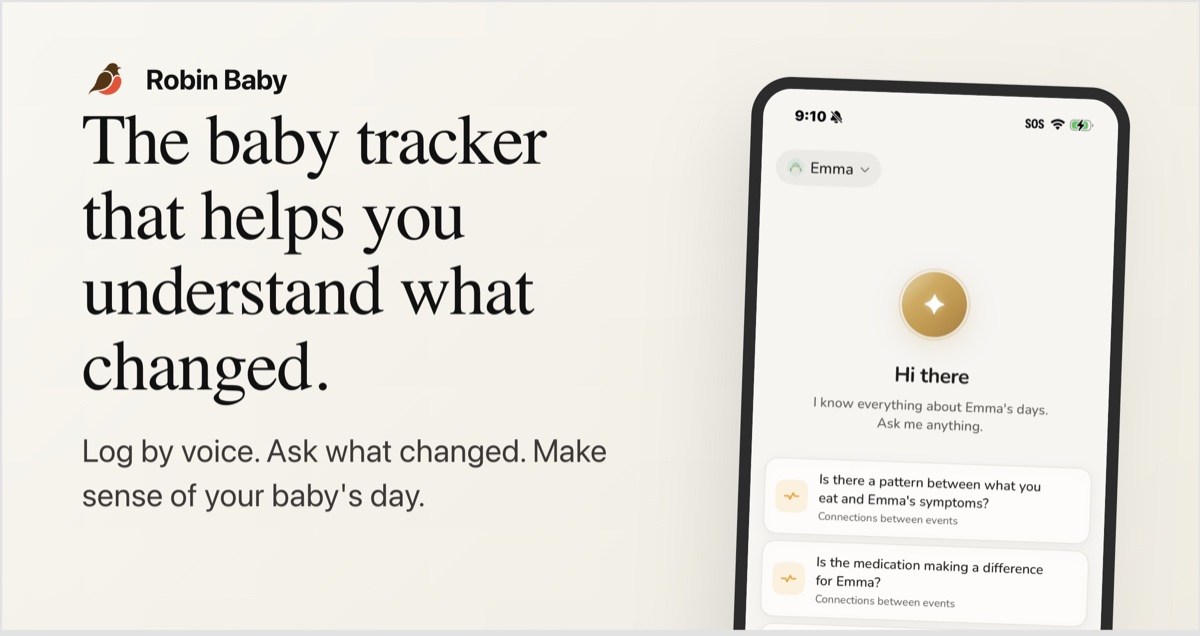
Keep that diary on your phone, free. Robin Baby (we make it) is a baby tracker with a My Diet log for what you eat, with a dairy tag, on the same timeline as your baby’s diapers (color, mucus), symptoms and feeds. Your partner can add entries too. iPhone · Android · How it works
Worried about breathing, green vomit or blood? Read the urgent-care list below first.
When to get urgent care
Start here. Some symptoms aren’t something to watch and log. These come from the NICE reflux guideline (NG1), the AAP’s HealthyChildren reflux guide and the NHS food allergy page.
Call 911 if your baby has trouble breathing, has swelling of the lips, face or tongue, or turns blue or goes limp.
Go to the emergency department now for green or yellow-green (bile-stained) vomit.
Get seen the same day if your baby has:
- Blood in vomit or spit-up
- Forceful, projectile vomiting, especially under 2 months
- Black, tarry stools, or more than a streak of blood in the stool
- Fever with vomiting, a swollen or tender belly, or seems unwell, floppy or unusually sleepy
- Far fewer wet diapers than usual, or refuses feeds
- Spit-up that turns into vomiting under 12 weeks of age
Call your pediatrician soon for any blood in the stool, poor weight gain, ongoing diarrhea, or spitting up that’s getting worse instead of better.
If you’re unsure, call. Nobody minds a cautious parent.
Reflux is common and doesn’t mean CMPA
Spitting up is one of the most normal things babies do. NICE says effortless regurgitation affects at least 40% of infants, usually starts before 8 weeks, and resolves in 90% of them before their first birthday. HealthyChildren puts it at about half of babies, and calls most of them “happy spitters”: they spit up, but they feed well, grow, and don’t seem bothered.
When reflux causes real trouble, like pain, feeding problems or poor growth, doctors call it GERD (GORD in the UK). Even then, milk allergy isn’t the usual cause. The ESPGHAN 2023 position paper on cow’s milk allergy says plainly that cow’s milk allergy “is unlikely to be responsible for regurgitation.”
For a breastfed baby who brings up feeds often and is clearly distressed, NICE’s first step isn’t a diet change. It’s a breastfeeding assessment by someone trained to do one, such as a lactation consultant. Latch, positioning and feed patterns can all play a part, and they’re quicker to check than a month without dairy.
Signs clinicians look for in breastfed babies
Cow’s milk protein allergy (CMPA, also called cow’s milk allergy) comes in two broad types.
- Immediate (IgE-mediated): hives, swelling, vomiting or breathing trouble within minutes to a couple of hours. This is very rare in exclusively breastfed babies.
- Delayed (non-IgE-mediated): the type most talked about with breastfeeding. Symptoms typically show up several hours to days after exposure, which is why they’re so hard to connect to a meal.
The delayed signs clinicians weigh include mucus or blood in the stool, eczema, persistent distress, vomiting, feeding refusal and poor weight gain. A specific form called allergic proctocolitis shows up as blood or mucus in the stool of a baby who otherwise looks well, usually starting at 2 to 6 weeks of age, according to ABM Clinical Protocol #24 from the Academy of Breastfeeding Medicine.
Now the honest part, because few pages say it. CMPA in exclusively breastfed babies is uncommon, and it’s overdiagnosed. ESPGHAN cites a study that found it in 0.5% of exclusively breastfed babies (3 of 569) at 3 months, and says that “CMA in exclusively breastfed infants exists, but is uncommon and suffers from over-diagnosis.” Higher figures have been reported, and ESPGHAN reads them as a sign of overdiagnosis. Many CMPA symptoms are also everyday baby things. ESPGHAN notes that “changes in stool characteristics, feeding aversion, or occasional spots of blood in stool are common and in general should not be considered as diagnostic of CMA.” It also notes that up to 20% of breastfed babies with symptoms such as rectal bleeding get better with no change to the mother’s diet.
None of this means your worry is wrong. It means a symptom alone doesn’t confirm CMPA. Your clinician looks at the history, examines your baby and, when it fits, suggests an elimination trial followed by reintroduction. That’s where a good diary comes in.
When clinicians suggest an elimination trial
If your pediatrician thinks CMPA is a real possibility, the usual next step is a diagnostic dairy-free trial while you keep breastfeeding. The guidelines agree on the shape of it:
- Plan it with a clinician, ideally with a dietitian. The World Allergy Organization’s 2023 DRACMA guidance on breastfeeding advises dietitian referral and says the evidence for maternal milk avoidance is “of limited strength,” and that for most breastfed babies with CMPA, a maternal elimination diet won’t be needed.
- It lasts about 2 to 4 weeks. That’s the window in ESPGHAN 2023, WAO DRACMA, ABM #24 and the 2018 NASPGHAN/ESPGHAN reflux guideline, which suggests it only after other non-drug steps haven’t worked.
- It ends with reintroduction. Dairy goes back into your diet to see whether symptoms return. That’s how the diagnosis is confirmed. WAO suggests a clear plan for reintroduction at home over about a week.
- If nothing changed, it stops. ESPGHAN stresses follow-up “to ensure that the exclusion of CM does not continue if not effective.” No improvement usually means going back to your normal diet, not cutting the next food.
If you want to know why the trial takes weeks rather than days, we wrote a separate piece on how long dairy stays in breast milk.
What to record before, during and after
A diary is the most useful thing you can bring to the appointment. The ABM protocol describes keeping “a very complete food diary for 2 weekdays and 1 weekend” so a clinician can see your usual eating and spot hidden sources. Delayed symptoms, dairy in unexpected foods and the need to compare phases all make memory unreliable.
Think of it in three phases:
- Baseline (your normal diet). A few days, ideally including a weekend, before you change anything. This is your “before” picture.
- Trial (dairy-free, 2 to 4 weeks). Keep logging the same things the same way, so the comparison is fair.
- Reintroduction (as your clinician plans it). Log what you ate and when, and what you saw over the following days.
Each day, write down:
- What you ate and drank, with times. Brand names help. Note anything you weren’t sure about, like a restaurant meal or a sauce.
- Stools: color, texture, mucus, any blood. A photo of an unusual diaper is worth taking.
- Spit-up or vomiting: roughly how much and how often.
- Fussiness and crying: when, how long, and whether your baby could be settled.
- Sleep, and anything unusual about it.
- Skin: new or worse rashes, dry patches, eczema.
- Feeds: how often, and whether your baby fed well or pulled off.
- Anything else: illness, vaccines, medicines, a new formula top-up, a slip-up with dairy.
A diary template you can copy
Prefer your phone? Every column below has a place in Robin Baby: meals go in My Diet, and the baby’s columns are diaper, symptom and feed entries. See how.
Copy this into a notebook, a spreadsheet or your phone’s notes. One row per meal or event is plenty.
| Date and time | Phase | What I ate or drank | Baby: stools | Baby: spit-up | Baby: fussiness | Baby: sleep, skin, feeds | Notes |
|---|---|---|---|---|---|---|---|
| Mon 8:00 a.m. | Baseline | Oatmeal with cow’s milk, coffee with cream | Yellow, seedy, no mucus | Small, after feed | Settled easily | Fed well; cheeks dry | |
| Tue 7:30 p.m. | Trial, day 3 | Chicken, rice, salad (checked dressing label) | Green, some mucus | None | Cried 40 min, hard to settle | Short nap; feeding fine | Photo of diaper taken |
The filled rows are examples to show the level of detail, not a pattern to look for.
At the end of each week, jot a two-line summary: how stools, spit-up, crying and skin compared with the week before. Your pediatrician will read that first.
Hidden dairy on labels
“Dairy-free” for CMPA means free of cow’s milk protein, not just milk you can see. Children’s hospital and NHS dietitian lists, such as CHOP’s milk allergy diet and NHS Lanarkshire’s CMPA guide, include these ingredient names:
- Casein, caseinates (sodium, calcium and others), rennet casein
- Whey, whey protein, whey solids, hydrolysed whey
- Milk solids, milk powder, skimmed milk powder, milk protein, modified milk
- Lactalbumin, lactoglobulin
- Butter, buttermilk, ghee, cream, cheese, curds, yogurt, sour cream, custard
A few traps:
- Lactose-free milk is still cow’s milk. CMPA is a reaction to the protein, not the sugar. NHS Lanarkshire puts it simply: lactose-free products “still contain milk protein.”
- Goat and sheep milk aren’t a swap. Their proteins are similar to cow’s milk, so NHS dietitians advise avoiding them too.
- “Nondairy” doesn’t mean milk-free. CHOP notes a nondairy label means no butter, cream or milk, but the product may still contain other milk ingredients, such as casein.
- Check the usual suspects: bread, crackers, processed meat, chips, sauces, soups and ready meals.
- “May contain milk” labels: advice varies. Ask your dietitian what they want you to do with these.
Looking after yourself
A dairy-free diet is real work. The WAO guidance names what many mothers feel: the time it takes to read every label, how isolating it can be at family meals and celebrations, and “feelings of guilt or anxiety” that your baby’s symptoms are coming from your food. If that’s you, it’s worth saying out loud: you didn’t cause this by eating yogurt. You’re doing a careful test because you’re paying attention.
Your own nutrition matters too. Dairy is a big source of calcium for many people, and WAO notes many women already eat less than the recommended 1,000 mg of calcium a day before cutting anything. Guidelines advise calcium and vitamin D supplements during a longer dairy-free diet, based on local recommendations, so ask your clinician or dietitian what amounts are right for you rather than guessing. A calcium-fortified plant milk can help fill the gap.
Try not to let the list keep growing. ESPGHAN and WAO both warn that long, unnecessary elimination diets can harm a mother’s nutrition and her confidence in breastfeeding. One food at a time, with a plan, is the safer path.
Reintroduction
This is the step people are most tempted to skip, because things feel better and nobody wants to rock the boat. But it’s what turns “things improved” into an answer. Symptoms can improve on their own over a few weeks, and ESPGHAN calls the challenge after a short elimination “the cornerstone of the diagnosis.”
Your clinician will tell you how to bring dairy back. WAO describes reintroducing at home over about a week. Keep logging exactly as you did before. If symptoms clearly return, that supports CMPA, and your clinician will advise how long to stay dairy-free. The ABM protocol suggests until the baby is 9 to 12 months old and for at least 6 months after diagnosis, with a plan for reintroducing dairy after that. If nothing comes back, you have your diet back, which is good news too.
How Robin Baby can hold your diary
We make Robin Baby, a baby tracker app, so weigh this with that in mind. You don’t need an app for any of the above. The template works fine on paper. But if your phone is the thing you’re always holding at 3 a.m., here’s what Robin Baby can keep in one timeline:
- My Diet log (free): what you ate, with tags such as dairy, soy, egg, gluten, peanut, tree nuts and others.
- Symptoms (free): a description plus mild, moderate or severe.
- Diapers (free): color, texture, mucus, rash and amount. There’s no separate field for blood, so add it in the diaper’s notes.
- Medications, notes and feeds (free), all on the same timeline.
- Sharing (free): up to three caregivers see the same log, so your partner’s 4 a.m. diaper entry is there when you need it.
With Premium, Robin’s assistant can summarize possible associations between the meals you logged and later symptom or diaper entries, to discuss with your clinician. It’s worth knowing exactly what it does and doesn’t do:
- It looks at a set window after each meal, about 48 hours. That window is a convenience for reading the log. It isn’t a medical reaction window.
- It only counts meals logged in My Diet, and symptoms or diaper entries. It doesn’t count crying logs, and “had cheese” typed into a plain note isn’t read as a meal.
- Missed entries, and foods you often eat together, make the results muddier.
- “No difference” doesn’t rule out an allergy.
- It doesn’t diagnose, and it won’t tell you what to eat or cut.
Premium is $9.99 a month or $59.99 a year in the US, and new accounts get 7 days free with no card. Robin Baby is on the App Store and Google Play.
In short
Most spit-up is normal, and CMPA in exclusively breastfed babies is uncommon. If your pediatrician thinks a dairy-free trial is worth trying, it’s 2 to 4 weeks, planned with them, followed by reintroduction, and it stops if nothing changes. Write down what you eat and what you see, before, during and after. That diary is the most useful thing you can bring to the appointment, and it means the decision gets made on evidence instead of exhaustion.
Questions about dairy-free breastfeeding
Should I cut out dairy if my breastfed baby has reflux?
Not as a first step on your own. Spitting up is very common and usually settles by age 1. For a breastfed baby who brings up feeds often and seems very distressed, NICE recommends a breastfeeding assessment first. A trial without dairy is something to plan with your pediatrician, usually for 2 to 4 weeks, and only when the history makes cow's milk protein allergy a real possibility.
How common is cow's milk protein allergy in breastfed babies?
Uncommon. ESPGHAN's 2023 position paper cites about 0.5% of exclusively breastfed babies in one study, says reported rates are almost always low, and warns that CMPA in breastfed babies is often overdiagnosed. Figures vary between studies, so ask your pediatrician what they see.
How long should a dairy-free trial last while breastfeeding?
Guidelines from ESPGHAN, NASPGHAN, the World Allergy Organization and the Academy of Breastfeeding Medicine all describe 2 to 4 weeks. After that, dairy goes back into your diet to see whether symptoms return. If nothing changed during the trial, the usual advice is to go back to your normal diet.
Can I have lactose-free milk if my baby might have CMPA?
No. CMPA is a reaction to milk protein, not milk sugar. Lactose-free milk is still cow's milk and still contains the protein. NHS dietitian leaflets also say to avoid goat and sheep milk, because their proteins are similar.
Do I need to cut out soy too?
Not routinely. Guidelines start with cow's milk only. If a milk-free trial doesn't help, a clinician may suggest another food, one at a time. Cutting several foods at once makes it hard to know what helped and makes your own diet harder to keep healthy.
Is mucus in my breastfed baby's poop a sign of CMPA?
Not on its own. ESPGHAN says changes in stool, feeding aversion and occasional spots of blood are common and in general should not be treated as proof of CMPA. Note it in your diary, and call your pediatrician if it keeps happening, if you see blood, or if your baby isn't feeding or growing well.
What should I bring to my pediatrician appointment?
A few days of what you ate and drank, with times, and what you noticed in your baby: stools (color, mucus, any blood), spit-up, fussiness, sleep, skin and feeds. Photos of unusual diapers help. A diary that covers a normal week, the trial and the reintroduction gives your clinician much more to work with than memory.
Is there an app to track my diet and my baby's symptoms while breastfeeding?
Yes. Robin Baby, which we make, has a free My Diet log for what you eat, with tags like dairy and soy, on the same timeline as your baby's diapers, symptoms, feeds and medicines. It's free on iPhone and Android, and up to three caregivers can log. Many baby trackers only log the baby's own food, so check for a mother's diet log before you choose.
Can an app tell me what food is upsetting my baby?
No app can diagnose an allergy. What an app can do is keep your meals and your baby's symptoms in one place with times. Robin Baby's Premium assistant can summarize possible associations between the meals you logged and later symptom or diaper entries, to discuss with your clinician. Only a clinician, usually with a trial and reintroduction, can tell you what's going on.
Tracking your baby's day with Robin?
Robin Baby is the voice-first baby tracker that remembers everything — feeds, sleep, growth, milestones. Free logging and timers, free caregiver sync.

